


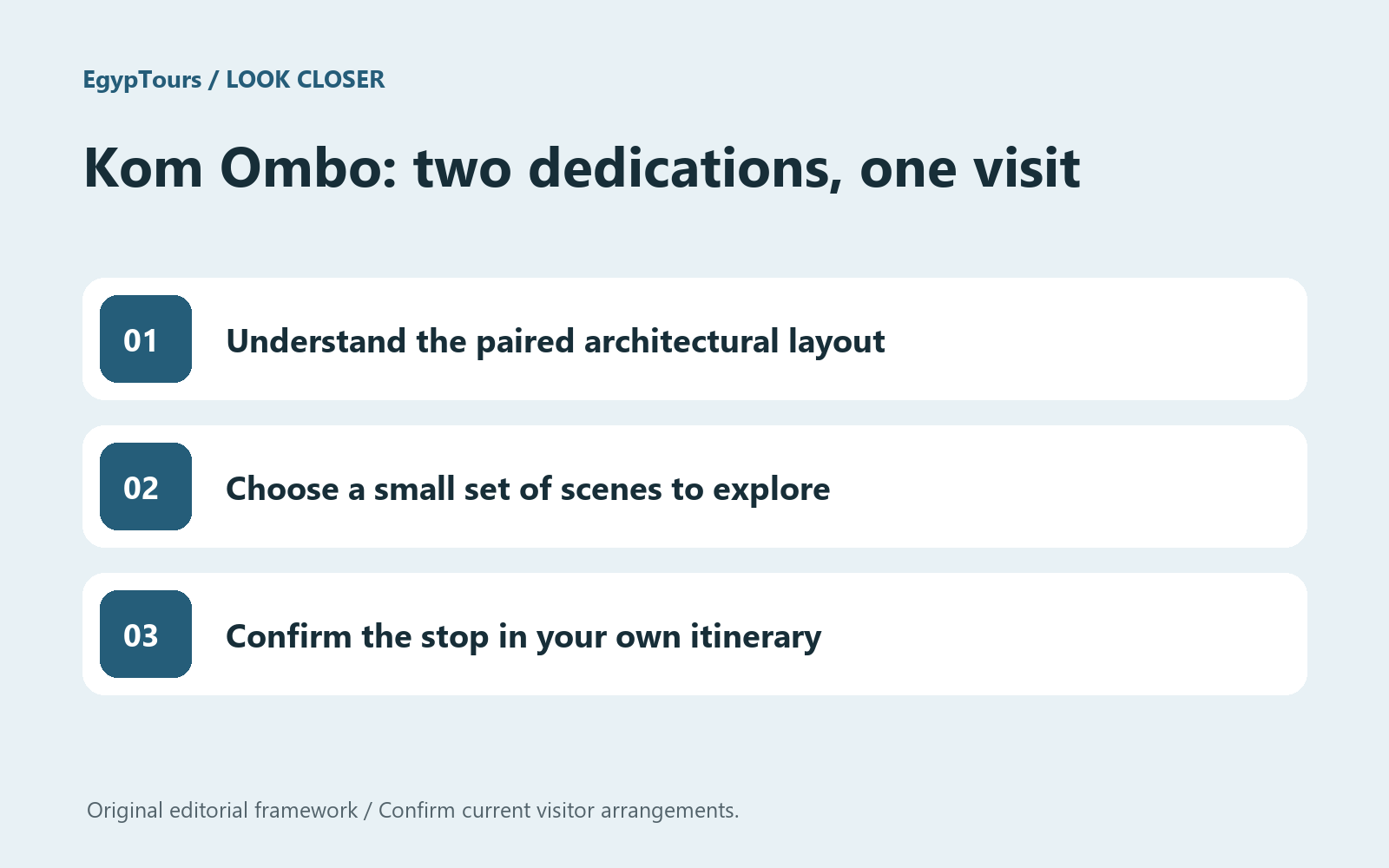
A Kom Ombo Temple visit becomes easier to follow once you recognize its paired layout. The site offers a clear opportunity to connect architecture with religious meaning, even on a focused stop within a wider itinerary. Start with the temple’s two dedications, choose a small set of details to explore and confirm the practical visit arrangements before travel.
Understand why the layout is paired
The Ministry of Tourism and Antiquities’ Kom Ombo guide explains that the temple honors Sobek, associated with the crocodile, and Har wer, or Horus the Elder, associated with the falcon. Its description links the two dedications to parallel routes through the halls and separate sanctuaries.
That relationship gives you a starting question for the guide: how does the building express the presence of two deities? Look at the overall arrangement before concentrating on individual scenes. You do not have to identify every carved figure to begin noticing how the architecture organizes the visit.
Distinguish the surviving structure from earlier history
The ministry dates the standing temple to the Graeco-Roman period and notes an earlier temple at the site. Ask which parts of the story relate to the building in front of you and which belong to the longer history of the place. This distinction is useful when a guide moves between different royal names or periods.
Rather than trying to record every date, choose a simple sequence: an earlier sacred site, the surviving building and its decoration. Ask your guide to explain an example visible on the route. That approach connects chronology to something you can observe and keeps a short visit from becoming a list of unfamiliar names.
Choose a few wall scenes to understand
The official overview highlights decorated columns, calendars of festivals and a scene commonly interpreted as showing surgical instruments. Treat that last subject as a question for discussion, rather than assuming that an image proves every modern claim made about ancient medicine. Ask the guide what the scene depicts and how its interpretation fits the surrounding temple setting.
Pick one architectural feature and one decorated scene as your main priorities. Ask what distinguishes the chosen examples and how they support the temple’s wider religious story. If you have time afterward, you can add another detail. A focused sequence is often more memorable than trying to photograph every surface.
Check how Kom Ombo appears in your cruise itinerary
If the stop forms part of a Nile cruise proposal, ask for the actual visit arrangements rather than treating the destination name as a complete description. Clarify when the organizer expects the visit to take place, how you reach the site from the vessel and where you meet again afterward. Follow the confirmed instructions supplied for your sailing.
Do not assume that a route title guarantees this stop, a particular duration or an evening visit. Read the day-by-day program and ask the organizer to identify any operational dependencies. Our Nile cruise inclusions guide helps separate the core program from optional arrangements.
Separate the temple visit from additional experiences
For any museum, other visitor area or extra activity mentioned alongside Kom Ombo, ask whether it is part of the confirmed route and whether admission and guiding are included. Do not infer the scope from a photograph, a general destination description or a reference to nearby attractions.
If you want independent time, clarify where it fits and how you return to the group or vehicle. Tell the organizer about walking or access requirements in advance and ask about the exact proposed route. A general description of the site cannot establish that every part will suit your needs.
Use a concise confirmation checklist
- The date and intended sequence of the visit.
- The meeting point, transport and return arrangements.
- The scope and language of guiding.
- The admissions and any additional areas explicitly included.
- The time available for independent viewing or photographs.
- The contact and procedure if the itinerary changes.
Keep those answers with your cruise or road itinerary. For broader route ideas, review the published EgypTours programs and ask which arrangements apply to your own dates. Availability and services need confirmation in the proposal, even when a destination appears in a program’s description.
Turn your interests into a better inquiry
Tell EgypTours whether your main interest is the paired architecture, the deities or particular decorated scenes. Include your travel dates and any existing cruise or accommodation commitment. Ask for the exact visit scope in writing before booking; this guide does not guarantee a departure, entry arrangement or included service.

