


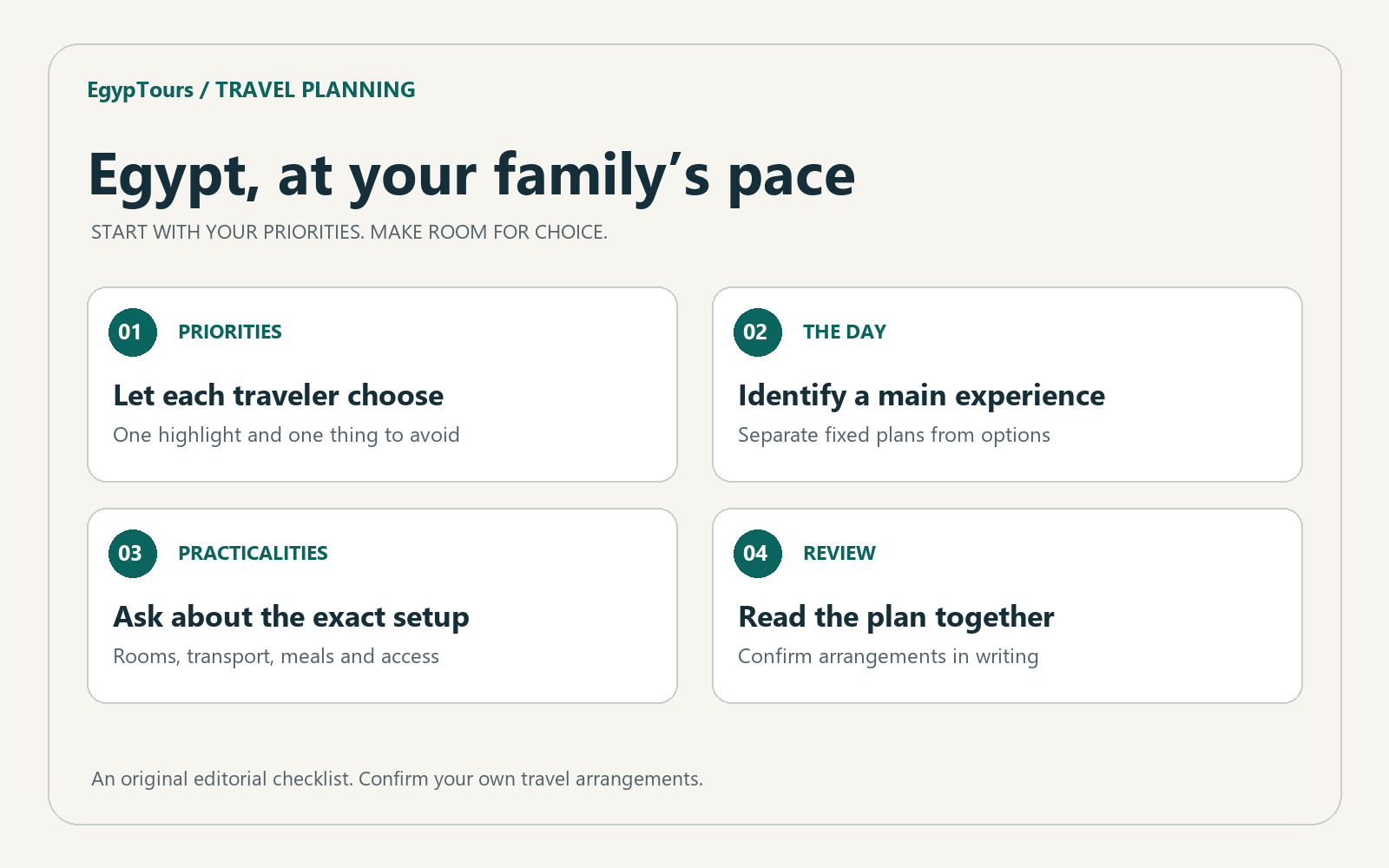
An Egypt itinerary with children should begin with the rhythm of your family, rather than an attempt to reproduce an adult sightseeing schedule. Identify what each traveler hopes to experience, how you want to spend time together and which practical arrangements need confirmation. Use those answers to shape the route before choosing a long list of visits.
Give each traveler a voice in the plan
Ask each family member to choose one highlight and one thing they would prefer to avoid. A child might want to see pyramids, enjoy time near the water or have space to draw and take photographs. Adults may have a different set of priorities. Put the answers on the same page so that quieter preferences do not disappear behind the most enthusiastic traveler’s list.
Describe those preferences in your inquiry. “We want a slower pace with room for breaks” is more useful than asking for a standard family package without explaining what family-friendly means to you.
Build around an anchor, then leave choices open
For each sightseeing day, identify one main experience and discuss what would be optional. This is an editorial planning method, not a limit that suits every child. It helps you see what can be adjusted without losing the main purpose of the day.
Ask your planner to distinguish between fixed arrangements and flexible ideas. A visit described as optional may still require a separate reservation, payment or decision deadline. Confirm that distinction before assuming you can change the program at any moment.
Make breaks part of the written outline
Instead of relying on “free time” to appear somewhere between stops, ask how meals, pauses and the end of the day will work. Share the routines you want to protect, without expecting the organizer to infer them from the children’s ages.
A break only helps if the arrangement works for your group. Ask where it could take place, what facilities can be confirmed and what would happen if you decide to finish sightseeing earlier. Do not interpret a suggested plan as a guarantee that every facility will be available at every site.
Check rooms, transport and meals individually
- Rooms: request the property name, room layout, occupancy and any connecting-room arrangement you need.
- Transport: give the organizer the information needed to confirm suitable seating and any specific equipment requirements.
- Meals: explain preferences and ask what the proposal can actually confirm, rather than assuming every request is included.
- Access: describe practical needs such as handling a pushchair or avoiding particular access barriers, then ask about the named stops.
- Changes: ask which adjustments are possible during the trip and how they affect the cost.
This article does not establish child-seat rules, medical suitability, entry-document requirements or the accessibility of a particular attraction. Check those matters with the relevant provider or authority for your family’s circumstances.
Compare the number of transitions, not just the number of sights
Review each change of hotel, vehicle or travel base. Ask what the family would need to do at each handover: pack, meet a new contact, wait for a room or keep certain belongings with them. Decide whether that transition adds an experience you value enough to justify the extra steps.
If a route includes both Cairo and Upper Egypt, ask for a clear explanation of the travel days as well as the sightseeing days. The published Egypt tour programs can provide ideas, but their titles alone do not prove that the arrangements suit your children.
Choose a preparation activity instead of more obligations
Consider a small activity that lets your children take ownership of the trip: choose a question to ask, make a simple drawing list or keep a short travel journal. Treat it as an invitation rather than a task that must be completed at every stop.
For belongings, use a short checklist based on the actual outing. The official visitor FAQ provides general travel information; check venue-specific requirements separately. Keep your own family’s necessary items and arrangements at the center of the decision.
Review the proposal as a family
Read the route from beginning to end before accepting it. Mark the fixed commitments, the activities you most want and the places where you hope for flexibility. Ask the supplier to resolve unclear wording about services and booking terms in writing.
If you are choosing accommodation for the Cairo portion, start with the Cairo and Giza route options and ask how the named hotel fits the daily sequence. Avoid assuming that a room photograph confirms its layout, suitability or availability for your dates.
Frequently asked questions
How many attractions should we plan each day?
There is no number this guide can prescribe for every family. Start with your priorities and routines, then ask for a sequence with clear choices and breaks.
Does “family-friendly” mean all services are included?
No inclusion should be inferred from that label. Ask for the rooms, transport, meals, visits and any special arrangements to be identified in the quotation.
Can we use an existing tour as a starting point?
Yes, as a conversation starter. Send EgypTours your family’s preferences and ask which changes can be confirmed for the route and dates you are considering.
Editorial basis: this is an original itinerary-planning framework, not a family safety certification or a statement that EgypTours provides every service mentioned. The linked official FAQ is general background, consulted on 28 October 2026.

